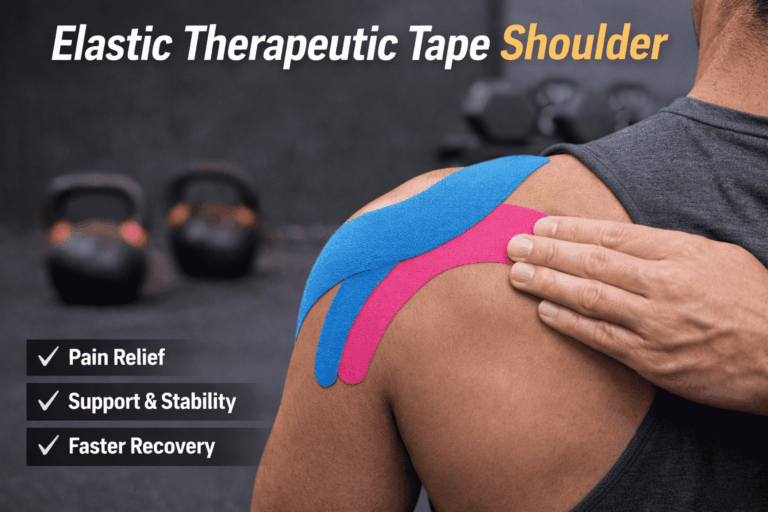
Ruban pour doigts de sport est désormais une partie importante à la fois de la santé sportive et de l’exercice personnel. Ce ruban adhésif spécial soutient les articulations et les tissus mous de l’extérieur, ce qui aide les gymnastes et autres personnes actives à éviter les accidents, à gérer les problèmes existants et à améliorer leurs performances. Savoir utiliser correctement le ruban de sport pour les doigts peut transformer votre quotidien et votre entraînement, que vous soyez un basketteur chevronné, un grimpeur ou simplement quelqu’un qui s’est foulé un doigt. Ce guide complet couvre tout ce qu’il faut savoir sur le ruban pour doigts de sport, de son application correcte à ses usages.
Qu’est-ce que le ruban pour doigts de sport ?
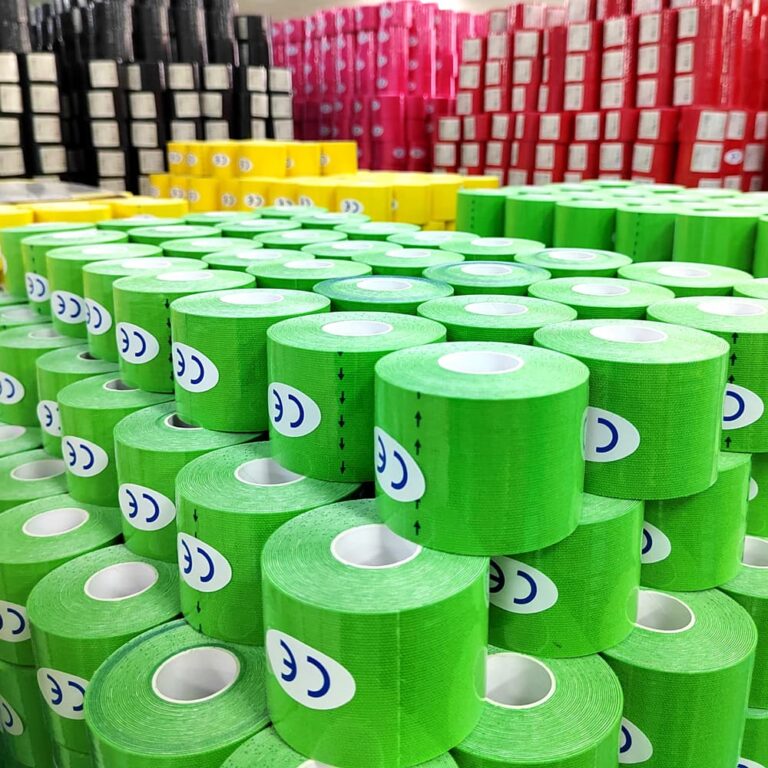
Il existe un ruban adhésif appelé « ruban pour doigts de sport » conçu pour soutenir et protéger les tissus mous et les articulations des doigts. Bande athlétique pour les doigts est différent de bande de kinésiologie et bandage cohésif pour doigts car il allie parfaitement flexibilité et rigidité. Il permet au doigt de bouger naturellement tout en offrant un soutien structurel. La plupart des bons rubans pour doigts de sport sont fabriqués en mélange de coton ou de polyester avec une colle à base d’oxyde de zinc qui adhère bien tout en étant douce pour la peau. Conçu pour résister à l’effort intense et à la transpiration, il reste en place malgré sa perméabilité et sa résistance à l’humidité.
La principale fonction du ruban pour doigts de sport est de soutenir les articulations sans les immobiliser complètement. Cette approche de « soutien fonctionnel » permet aux sportifs de maintenir leurs performances tout en réduisant les risques de blessures ou en évitant l’aggravation des affections existantes. Le ruban renforce les structures naturelles du corps, comme les ligaments et les tendons, et fournit un retour proprioceptif qui accroît la conscience corporelle et améliore le contrôle des mouvements.
Principaux usages du ruban pour doigts de sport
Prévenir et soigner les blessures
Une raison courante d’utiliser le ruban de sport sur les doigts est de les protéger contre les blessures. Des sports comme le basketball, volley-ball, le football, le rugby, Jiu-Jitsu et les arts martiaux, qui impliquent des prises, des lancers, des saisies ou des contacts aux mains, sollicitent énormément les articulations des doigts. Bandage préalable des doigts fragiles renforce les articulations et réduit les risques d’hyperextension, d’entorses et de luxations. Nombre de joueurs bandent leurs doigts avant les matchs comme mesure de sécurité, particulièrement ceux ayant déjà subi des blessures aux doigts.
Gérer les blessures existantes
De nombreuses personnes souffrant déjà de blessures aux doigts considèrent le ruban pour doigts de sport comme un élément clé de leur rétablissement. Parmi les affections courantes que le bandage peut aider à traiter :
- Entorses légères des articulations des doigts dues à un choc latéral
- Doigt en maillet : lésion du tendon extenseur au niveau de l’articulation distale
- Déformation en boutonnière : lésion de la partie centrale du tendon extenseur.
- Entorses ligamentaires : étirement ou déchirure des ligaments de l’articulation du doigt.
- Tendinite : inflammation des tendons du doigt.
Utilisé correctement, le ruban pour doigts de sport fournit le soutien nécessaire à la guérison tout en permettant une mobilité normale du doigt, essentielle pour les tâches quotidiennes et un retour progressif au sport.
Améliorations des performances
Outre la protection contre les blessures, de nombreux sportifs utilisent le ruban pour doigts de sport pour optimiser leur efficacité. Dans des disciplines comme basket-ball, cricket, des doigts correctement bandés peuvent vous aider à vous sentir plus confiant lors de la manipulation du ballon. Les grimpeurs sur roche bandent souvent leurs doigts pour éviter que la peau ne se déchire et pour obtenir un soutien supplémentaire lorsqu’ils s’accrochent fermement. Les haltérophiles peuvent bander leurs doigts aux barres pour maintenir leur prise et empêcher leurs callosités de se rompre. L’apport proprioceptif du bandage peut également améliorer les connexions nerveuses vers les doigts, ce qui pourrait favoriser les compétences motrices fines dans certains sports.
Avantages pour les orteils : accroître l’utilisation
Bien que ce guide porte principalement sur le bandage sportif pour les doigts, il est important de se souvenir que les mêmes principes et souvent les mêmes produits peuvent servir à protéger vos orteils. Bande de sport pour les orteils offre le même bénéfice aux membres inférieurs, particulièrement dans les sports qui sollicitent les articulations des pieds et des orteils.
Utilisations courantes pour les orteils
Turf toe: Lorsque l’articulation du gros orteil est hyperextendue, ce qui arrive fréquemment au football américain et au soccer
Traiter les ampoules :Comment éviter et soigner les ampoules et points chauds en course et escalade
Prévenir les entorses d’orteils :Comment éviter et soigner les entorses et fractures d’orteils Aider au processus de guérison
Soulagement de l’orteil en griffe : en réduisant la pression et les frottements dans les chaussures
Danse et arts martiaux : en protégeant les orteils lors des pivots et des pas
Les étapes pour appliquer un bandage sportif sur les orteils sont très similaires à celles pour les doigts, avec quelques adaptations pour prendre en compte l’anatomie unique des pieds et leurs besoins mécaniques. Nombre de sportifs devant protéger à la fois leurs doigts et leurs orteils utilisent le même ruban adhésif sportif pour les deux. Cela en fait un élément indispensable dans toute trousse de sport.
Qui utilise le bandage sportif pour les doigts ?
Athlètes professionnels et amateurs
Les athlètes issus d’une grande variété de sports sont les utilisateurs les plus évidents du bandage sportif pour les doigts. Bandage des doigts est une pratique courante chez les basketteurs pour protéger les doigts foulés au contact du ballon ou d’autres joueurs. Le bandage protège les doigts des volleyeurs lors des blocs et des services. Les joueurs de football américain et les demis de coin bandent leurs doigts ensemble pour éviter les luxations lors des réceptions ou des plaquages. Les pratiquants d’arts martiaux bandent leurs doigts pour stabiliser leurs articulations lors des frappes et des projections. Les grimpeurs sur roche figurent parmi les utilisateurs les plus assidus. Ils recourent à des techniques complexes pour soutenir les poulies digitales et prévenir les lésions tendineuses en ascension.
Haltérophiles et adeptes de la musculation
Au-delà des sports classiques, de plus en plus d’amateurs de fitness recourent au bandage sportif pour les doigts lorsqu’ils haltérophilie. Les crossfiteurs bandent leurs pouces et doigts aux barres pour tenir lors des sauts olympiques, muscle-ups et tractions. Les powerlifters utilisent du bandage pour préserver leurs callosités lors des soulevés de terre. Les gymnastes en font un usage systématique pour protéger leurs mains au travail aux barres et maintenir la force de préhension requise.
Utilisateurs en milieu professionnel
Le bandage sportif pour les doigts peut également bénéficier à certains métiers. Dans le cadre de protocoles thérapeutiques, les kinésithérapeutes bandent souvent les doigts de leurs patients. Pour un soutien additionnel lors de tâches répétitives, les ouvriers du bâtiment ou de l’industrie bandent parfois leurs doigts. Certains musiciens, tels que les cordistes ou les batteurs, adoptent des techniques spécifiques pour protéger leurs doigts tout en préservant leur mobilité.
Patients en rééducation
Dans le cadre de leur rétablissement, les personnes ayant subi une chirurgie des mains, une fracture osseuse ou une lésion tendineuse recourent fréquemment au bandage sportif pour les doigts. Ce dernier leur apporte un soutien progressif, servant de transition entre l’immobilisation et la pleine fonctionnalité au fur et à mesure qu’ils retrouvent force et mobilité.
Techniques courantes de bandage et leur réalisation
Bandage simple « buddy »
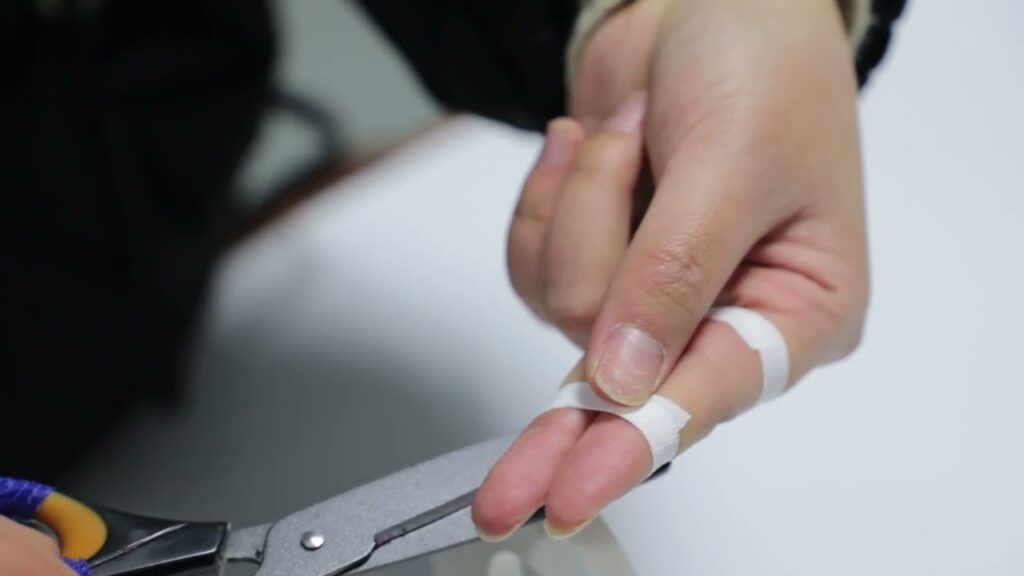
Le bandage « buddy » est la méthode la plus élémentaire pour appliquer un bandage sportif sur les doigts. Il consiste à fixer le doigt lésé au doigt adjacent sain, ce dernier servant d’attelle naturelle.
Pour réaliser un bandage « buddy » correctement :
- Coupez le ruban adhésif pour doigts de sport en deux bandes.
- Pour éviter que vos doigts se frottent l’un contre l’autre, placez un petit morceau de gaze ou de mousse entre eux.
- Placez une bande au-dessus de l’articulation blessée et une en dessous pour maintenir le doigt blessé contre son voisin.
- Assurez-vous que le ruban est serré sans entraver la circulation sanguine.
- Lorsque les phalanges sont foulées ou fracturées mais stables, cette méthode est idéale.
Ruban pour stabiliser les articulations (Méthode en huit)
- Collez une bande de sparadrap sportif pour doigts sur la face palmaire de votre main, sous le doigt.
- Pliez la bande en deux et remontez-la en travers de l’articulation.
- Refaites un tour autour du doigt en formant un « X » au-dessus de l’articulation pour la maintenir en place.
- Terminez la forme en huit et fixez la bande de l’autre côté.
- Cette méthode offre un soutien multidirectionnel tout en permettant la flexion.
Soutien pour grimpeurs avec système de poulie
- Enroulez une fine bande de sparadrap sportif pour doigts autour du doigt au niveau de la poulie.
- Utilisez des bandes plus fines pour former un « X » sur la zone de la poulie.
- Maintenez-la en place avec des bandes circulaires supplémentaires au-dessus et en dessous.
- Cette méthode de « strapping en H » soutient spécifiquement la gaine tendineuse tout en permettant au doigt de bouger librement pour les autres mouvements.
Stabilisation du pouce (spica du pouce)
- Enroulez du sparadrap sportif autour de votre poignet pour ancrer les doigts.
- Enroulez la bande autour du pouce et en travers de l’articulation du pouce.
- Revenez vers l’ancrage au poignet et formez une boucle de soutien.
- Ajoutez d’autres bandes pour renforcer la stabilité.
- Pour les sports impliquant des prises et les affections comme l’entorse du pouce du gardien de but, cette technique est particulièrement efficace.
Strapping sportif pour la sécurité
- Protection de l’extrémité en strappant uniquement l’articulation distale pour éviter les blessures des ongles
- Bandes en travers des articulations : simples bandes passant sur les articulations fragiles pour prévenir l’hyperextension.
- Renfort aux contours : enroulement léger autour des doigts souvent coincés
Comment choisir le meilleur sparadrap sportif pour vos besoins
Critères importants à considérer
Lors du choix d’un sparadrap pour doigts de sport, tenez compte de ces caractéristiques du matériau :
Perméabilité à l’air : Les mélanges de coton permettent généralement une meilleure circulation d'air que les options synthétiques
Élasticité : Le ruban non extensible offre le meilleur soutien, tandis que le ruban élastique permet une plus grande liberté de mouvement.
Adhésivité : Les adhésifs à l'oxyde de zinc assurent la meilleure tenue, même en cas de transpiration et de mouvements.
Facilité de déchirure : Certains rubans se déchirent à la main, tandis que d'autres nécessitent des ciseaux.
Largeur:Le ruban pour doigts de sport à usage général est plus large (environ 2,5 cm ou 1 pouce) que le ruban spécifique aux doigts
Modèles imperméables : pour la natation et le port de plusieurs couches de vêtements
Options hypoallergéniques : Pour les personnes à peau sensible ou sujettes aux réactions aux adhésifs
Rubans colorés et imprimés : pour assortir à votre équipe ou à votre style personnel
Accessoires pour l'application
Pour optimiser l'efficacité de votre ruban pour doigts de sport, associez-le à ces produits complémentaires :
Underwrap: Une couche de mousse ou de tissu qui protège la peau et réduit le contact adhésif direct
Spray adhésif : améliore la tenue du ruban pour une utilisation prolongée
Dissolvant pour bande : produits qui décomposent la colle pour permettre un retrait sans douleur
Les extrémités effilées des ciseaux permettent de couper en sécurité près de la peau
Conseils pour une application et un retrait corrects
Préparer la peau
- La préparation de la peau est la première étape d’une application réussie :
- Nettoyez et séchez bien vos doigts
- Rasez les zones abondamment poilues pour améliorer l’adhérence.
- Utilisez un sous-wrap si nécessaire, particulièrement en cas de peau sensible.
- Pour une adhérence renforcée, utilisez un spray adhésif.
- N’appliquez pas d’huiles ou de crèmes juste avant la pose du tape.
Instructions d’utilisation
Lors de la pose de tape de sport sur vos doigts, respectez ces règles :
- Positionnez les doigts dans une posture fonctionnelle, légèrement fléchis, pour appliquer le tape.
- Appliquez une tension uniforme, sans serrer excessivement pour éviter d’entraver la circulation sanguine.
- Lissez le tape au fur et à mesure pour éviter les plis et assurer une adhérence uniforme.
- Superposez le nouveau tape sur l’ancien sur la moitié de sa largeur afin qu’il reste bien en place.
- Laissez les lits unguéaux visibles pour contrôler la circulation sanguine.
Méthodes sécurisées de retrait
Un nettoyage approprié prévient les lésions cutanées :
- Retirez-le lentement, dans le sens de la pousse des poils.
- Si le tape résiste, utilisez un dissolvant d’adhésif médical ou de l’huile pour décomposer la colle.
- Ne l’arrachez pas brusquement, surtout dans les zones poilues.
- Après retrait, lavez la peau au savon et à l’eau pour éliminer tout résidu de colle.
- Laissez la peau respirer entre les sessions de taping.
Maintenir les performances et surveiller l’efficacité
Vérifications régulières
Lorsque vous protégez régulièrement vos doigts avec du tape de sport, vérifiez périodiquement :
- Efficacité : Le tape remplit-il sa fonction attendue ?
- Confort : Le ruban fait-il mal à votre peau ou l'irrite-t-il ?
- Mobilité : Conservez-vous l'amplitude de mouvements nécessaire ?
- Santé de la peau : La peau reste-t-elle saine après l'application du ruban ?
Quand consulter un professionnel
Le ruban sportif sur les doigts est idéal pour protéger contre les petites blessures et les traiter, mais consultez un médecin si :
Incapacité à bouger ou à étirer le doigt ; engourdissement ou picotements durant plus qu'un bref instant ;
S'il y a des signes d'infection autour d'une blessure et que les symptômes ne s'améliorent pas après quelques jours de repos et de protection,
En résumé, intégrer du ruban adhésif sportif à votre mode de vie actif
le ruban adhésif pour doigts de sport est un outil simple mais précieux pour les personnes qui sollicitent beaucoup leurs mains. Appliquer correctement le ruban pour doigts de sport peut faire la différence entre une performance stable et des blessures frustrantes, que vous soyez un athlète professionnel ou un amateur du week-end. En maîtrisant les différentes techniques d’enveloppement, en choisissant les bons matériaux et en suivant les bonnes méthodes d’application, vous pourrez soutenir efficacement vos doigts dans n’importe quelle activité.
Gardez à l’esprit que le ruban adhésif pour doigts de sport est un excellent moyen de protéger vos doigts des blessures, mais qu’il ne doit pas remplacer un entraînement approprié, des compétences et un développement de la force. Le ruban sportif peut vous aider à repousser vos limites tout en réduisant les risques des activités choisies, mais seulement si vous l’utilisez judicieusement dans le cadre d’un plan complet pour la santé et la réussite manuelle.
Apprendre à utiliser le ruban adhésif pour doigts de sport est une compétence utile qui vous servira tout au long de votre vie trépidante, que vous vous prépariez pour une course, que vous récupériez d’une blessure ou que vous souhaitiez simplement améliorer votre prise lors des entraînements.
En tant que fabricant de ruban adhésif pour doigts de sport, nous proposons des services de vente au détail et en gros. Si vous êtes un acheteur individuel, cliquez sur «acheter du ruban pour doigts maintenant» pour commander en ligne. Si vous êtes un grossiste ou un détaillant, laissez-nous un message et nous vous contacterons dans les 24 heures.